With 50 films to go... Has your favourite been and gone or is it still waiting to be called. Would love to hear your views...
82. FORREST GUMP - 1994
81. AROUND THE WORLD IN EIGHTY DAYS - 1956
80. CIMARRON - 1931
79. CRASH - 2005
78. BRAVEHEART - 1995
77. ROCKY - 1976
76. TOM JONES - 1963
75. THE GREATEST SHOW ON EARTH - 1952
74. THE BROADWAY MELODY - 1929
73. TERMS OF ENDEARMENT - 1983
72. GOING MY WAY - 1944
71. GANDHI - 1982
70. DRIVING MISS DAISY - 1989
69. CAVALCADE - 1933
68. CHARIOTS OF FIRE - 1981
67. DANCES WITH WOLVES - 1990
66. OLIVER! - 1968
65. THE DEER HUNTER - 1978
64. A BEAUTIFUL MIND - 2001
63. ANNIE HALL - 1977
62. GENTLEMAN'S AGREEMENT - 1947
61. OUT OF AFRICA - 1985
60. SHAKESPEARE IN LOVE - 1998
59. A MAN FOR ALL SEASONS - 1966
58. MRS MINIVER - 1942
57. HURT LOCKER - 2009
56. HAMLET - 1948
55. THE LORD OF THE RINGS: RETURN OF THE KING - 2003
54. PLATOON - 1986
53. THE LIFE OF EMILE ZOLA - 1937
52. GIGI - 1958
51. ONE FLEW OVER THE CUCKOO'S NEST
STILL TO COME
WINGS - 1928
ALL QUIET ON THE WESTERN FRONT - 1930
GRAND HOTEL - 1932
IT HAPPENED ONE NIGHT - 1934
MUTINY ON THE BOUNTY - 1935
THE GREAT ZIEGFELD - 1936
YOU CAN'T TAKE IT WITH YOU - 1938
GONE WITH THE WIND - 1939
REBECCA - 1940
HOW GREEN WAS MY VALLEY - 1941
CASABLANCA - 1943
THE LOST WEEKEND - 1945
THE BEST YEARS OF OUR LIVES - 1946
ALL THE KING'S MEN - 1949
ALL ABOUT EVE - 1950
AN AMERICAN IN PARIS - 1951
FROM HERE TO ETERNITY - 1953
ON THE WATERFRONT - 1954
MARTY - 1955
THE BRIDGE ON THE RIVER KWAI - 1957
BEN-HUR - 1959
THE APARTMENT - 1960
WEST SIDE STORY - 1961
LAWRENCE OF ARABIA - 1962
MY FAIR LADY - 1964
THE SOUND OF MUSIC - 1965
IN THE HEAT OF THE NIGHT - 1967
MIDNIGHT COWBOY - 1969
PATTON - 1970
THE FRENCH CONNECTION - 1971
THE GODFATHER - 1972
THE STING - 1973
THE GODFATHER II - 1974
KRAMER VS KRAMER - 1979
ORDINARY PEOPLE - 1980
AMADEUS - 1984
THE LAST EMPEROR - 1987
RAIN MAN - 1988
SILENCE OF THE LAMBS - 1991
UNFORGIVEN - 1992
SCHINDLER'S LIST - 1993
THE ENGLISH PATIENT - 1996
TITANIC - 1997
AMERICAN BEAUTY - 1999
GLADIATOR - 2000
CHICAGO - 2002
MILLION DOLLAR BABY - 2004
THE DEPARTED - 2006
NO COUNTRY FOR OLD MEN - 2007
SLUMDOG MILLIONAIRE - 2008
Wednesday, 28 April 2010

51. ONE FLEW OVER THE CUCKOO'S NEST - 1975
I appreciate that most people would place this film much higher on the list. It is regarded a classic and is (at time of writing) in the top ten films ever on the IMDB website. Personally, I would not put it this high.
‘One Flew Over The Cuckoo’s Nest’ is the tale of McMurphy (Jack Nicholson), a convicted criminal who decides that rather than being in prison it would be easier to pretend that he is mad and spend time in a mental institution. Once in the asylum he tries to liven the place up with games and general high jinx, but finds himself clashing with the head nurse, the formidable Nurse Ratched (Louise Fletcher), who wants order and routine returned to the hospital.

As it is only the second of three films to win the big five awards, the two leads cannot be ignored. Nicholson is over-the-top as always. He plays McMurphy will a manic joy that only he could. Nicholson is not one of my favourite actors, I find that his default mode is over-the-top no matter what the part, even in more serious films such as ‘The Departed’, which is yet to come on the countdown, and whereas this film is set in an asylum, I’m not as transfixed by his performance as I would have liked to have been, because I’d seen it all before.
Fletcher’s performance I prefer much much more. She manages to be cold and joyless and manages to control the film whenever she is on the screen, which is remarkable as she does very little throughout the duration. Whenever she is not in the film I either found my attention waning or I became annoyed by Nicholson’s character, neither of which I wanted.
My problem with the film (I say problem loosely, it’s still manages to make it near the middle of my ranking) is that it’s so of its era, that I find it bares very little relevance today. Nicholson is supposed to be the hero, but in reality he’s a criminal who main aim is to destroy an institution. Fletcher is supposed to be this big villain, on the American Film Industry’s List of 50 Villains of all time she appears at number 5, one place below The Wicked Witch of the West and 10 places above Ralph Fiennes in ‘Schindler’s List’ and why…? Because she tried to restore some order in an asylum whilst some criminal is running amok.
It’s a film very much of its age. It’s an anti-establishment film and as such an important film it should be watched as a simple of its age, but do I think it’s a great film? No. I think that the characters are largely simplified to the point that they become too obvious and that Nicholson over-acts for the majority of the film. The story is actually pretty good given the characters provided, and from a technical point of the film is fine, given the confines of an asylum, but there are very little opportunities for glorious sweeping shots of dramatic scenery, and it cannot be considered a great film on this front. In short I appreciate the finer points of this film, but ultimately it enters the category of films that I consider to be important rather than brilliant.
52. GIGI - 1958
After winning the Best Picture Oscar for ‘An American in Paris’ but failing to clinch the Best Director award, Minnelli returned with ‘Gigi’ and secured nine Academy Awards in the process. For such a successful musical it has always struck me as a slightly odd film, and this is mainly to do with the subject matter.
Gigi (Leslie Caron) is a young girl in 1900s Paris who is being trained to be a courtesan. Her grandmother used to be the mistress of Horore Lachaille (Maurice Chevalier) and his nephew Gaston (Louis Jourdan), a turn-of-the-Century playboy, spends more and more time with the young girl as he is bored of his hedonistic lifestyle. As can be expected, the two young people’s friendship gradually develops into something more.

The film has many wonderful musical numbers. The song ‘Gigi’ scooped the Best Song Oscar and a personal favourite is the delightfully witty ‘I Remember it Well’. One of the most famous songs is ‘Thank Heaven for Little Girls’: it is an absolutely excellent song, sung perfectly by Chevalier.
Caron is delightful in the title role. Whereas I prefer ‘An American in Paris’ to ‘Gigi’ overall, I think that she is stronger in this and she plays the role with charm and ease. Jourdan is a perfect choice as the love interest: brooding, charming but a little insecure, and Chevalier was, again, an inspired choice.
The best thing about the film is how it is filmed. One of the earliest colour winners, ‘Gigi’ is delightfully shot. The colours used, the costumes, the make-up are all stunning, and from a visual perspective, the film is easily one of the greatest triumphs of cinema.
What stops this film, for me, being higher up the list is the aforementioned subject matter and story. This is a musical which is supposed to be a big romance, but is actually when it’s stripped down it’s about a young girl who is essentially being trained to be a high-class escort and a man about town several years older than her. This in itself is fine, ‘Moulin Rouge’ manages to do this but doesn’t try to hide it. ‘Gigi’ (maybe because of when it was made) almost seems to hide this and makes their relationship look wholesome, whereas in reality it’s all a little bit seedy.
This is a small criticism: It is a beautiful film, but this flaw always makes me a little uncertain when I watch it. I wish that the film had either been made to be more traditional and to cut out the courtesan aspect, or to actually address the issue at hand. As it stands it just seems a little odd at times, despite the fact it is one of the most beautifully shot musicals ever made.
53. THE LIFE OF EMILE ZOLA - 1937
Another film which I have seen towards the bottom of many best picture rankings is this little known late 1930s biopic of one of France’s most famous authors. The film is largely about his involvement in the Dreyfus affair, but also takes a look into his literature, and I quite comprehend why it is often dismissed as one of the weakest winners of this award.
The film starts with Zola’s early life. He is a struggling author and close friends with Paul Cezanne, and more interested writing a social commentary than ever he is with making money. Over the course of the film he becomes more successful and this is told largely though a montage of his work. The bulk of the film concentrates itself with the Dreyfus affair. Dreyfus was arrested and sent to Devil’s island, convicted of treason, but new information soon comes to light that suggests that he is innocent. The military, however, want to suppress this information as it would dampen moral, but Zola decides to speak out in one of the earliest examples of courtroom drama.

Zola is played by Paul Muni, who ages expertly during the film. He won the Best Actor the year before for playing Louis Pasteur, but this performance would have been a worthy win too. He really does control the screen and the film is clearly about him. The supporting cast are solid. There is, for me, no performance that really stands out as fantastic, but pleasingly there are no weak links.
The best word to describe ‘The Life of Emile Zola’ is solid. This film is the first in the list that I find difficult to really fault. There is nothing that I can find wrong with it. Equally, it’s not a spectacular film, and I would find it hard to believe that there are many people who would have a deep love for this film. The majority of the film tells the story of the life of Zola in an effective, interesting but not particularly inspiring way. You get an essence of the man without really becoming overly involved in the film.
There are a couple of really high spots in this film. Perhaps it would be hard to create a bad version of the famous ‘J’accuse’ speech, but nevertheless it is a pretty special moment. The last section of the film in the courtroom is also brilliant. It gives an lasting impression and would easily come near the top of my favourite courtroom drama moments.
I have heard people describe this film as dated and criticise it because of this. It is dated in many ways: if this film were to be made today it would have completely different feel about it (if this film were to be made today I think it would be a bit like ‘Milk’ in style), but this also makes the film have a certain charm. There are some things, as well, that are important no matter how old a film, and that is intelligent, sensible and solid acting, and ‘The Life of Emile Zola’ succeeds in this for sure.
The film starts with Zola’s early life. He is a struggling author and close friends with Paul Cezanne, and more interested writing a social commentary than ever he is with making money. Over the course of the film he becomes more successful and this is told largely though a montage of his work. The bulk of the film concentrates itself with the Dreyfus affair. Dreyfus was arrested and sent to Devil’s island, convicted of treason, but new information soon comes to light that suggests that he is innocent. The military, however, want to suppress this information as it would dampen moral, but Zola decides to speak out in one of the earliest examples of courtroom drama.
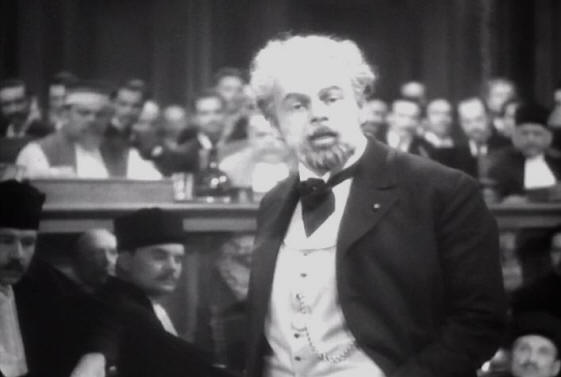
Zola is played by Paul Muni, who ages expertly during the film. He won the Best Actor the year before for playing Louis Pasteur, but this performance would have been a worthy win too. He really does control the screen and the film is clearly about him. The supporting cast are solid. There is, for me, no performance that really stands out as fantastic, but pleasingly there are no weak links.
The best word to describe ‘The Life of Emile Zola’ is solid. This film is the first in the list that I find difficult to really fault. There is nothing that I can find wrong with it. Equally, it’s not a spectacular film, and I would find it hard to believe that there are many people who would have a deep love for this film. The majority of the film tells the story of the life of Zola in an effective, interesting but not particularly inspiring way. You get an essence of the man without really becoming overly involved in the film.
There are a couple of really high spots in this film. Perhaps it would be hard to create a bad version of the famous ‘J’accuse’ speech, but nevertheless it is a pretty special moment. The last section of the film in the courtroom is also brilliant. It gives an lasting impression and would easily come near the top of my favourite courtroom drama moments.
I have heard people describe this film as dated and criticise it because of this. It is dated in many ways: if this film were to be made today it would have completely different feel about it (if this film were to be made today I think it would be a bit like ‘Milk’ in style), but this also makes the film have a certain charm. There are some things, as well, that are important no matter how old a film, and that is intelligent, sensible and solid acting, and ‘The Life of Emile Zola’ succeeds in this for sure.
Saturday, 24 April 2010
54. PLATOON - 1986
‘Platoon’ is Oliver Stone’s ultimate Vietnam film which focuses on a platoon of American soldiers as they fight together in the Vietnamese wilderness.
The main character is Chris Taylor (Charlie Sheen) who is a volunteer and an inexperienced fighter and not as indispensable as he believed he would be. We meet the other members of the platoon and see them go through training and fighting together. The platoon is split in two when a violent killing takes place during a raid on a village. The film then looks at the two conflicts: the conflict within the platoon and the conflict of the war.

‘Platoon’ is undoubtedly one of the great war films. The acting is solid throughout, with a surprisingly good performance from Sheen and great performances from the two commanders Barnes (Tom Berenger) and Elias (Willem Dafoe) whose rivalry really does elevate this film to higher levels.
The film is shot beautifully: there are some shocking and moving moments of the film, and the film really does show the panic that it intends to portray. It’s also a balanced film in that it’s clearly anti-war, but refrains from becoming either anti-American or anti-Vietnamese, and the film deserves credit for that. The use of the two confrontations really helps to do this, and I think that it was a great decision to introduce this internal conflict into the film.
The film is not without its faults and suffers at time from a common war film flaw in that it tries to put too many events into a short time period. Whereas I do not doubt that these events did take place in Vietnam, it is highly unlikely that they would have taken place to one group of people within a time frame of a few weeks.
Whereas the cinematography of the war scenes is stunning and illustrates the general confusion of war, at times this scenes do drag as once the idea of confusion has passed it can turn into a series of loud bangs and flashing lights, and I personally felt my attention waning at some of these points.
Platoon is a war film that everyone should watch. It is a cleverly constructed film which gives an interesting insight into life in Vietnam. It’s not perfect: there are parts where the expression style over substance can be applied, but on the whole it is a strong film with many good qualities. Incidentally, my winner would have been ‘A Room with a View’, in my opinion one of the greatest films of the 1980s.
Friday, 16 April 2010
55. THE LORD OF THE RINGS: THE RETURN OF THE KING - 2003
I cannot justify delaying the ranking of this film any longer. I realise that this film is often heralded as the greatest film of the last decade, and it did achieve both commercial and critical success, but it’s not one of the greatest Best Picture winners ever.
‘The Return of the King’ is the final part of the ‘Lord of the Rings’ trilogy, and it’s difficult to review one without reviewing them all. The story is a faithful adaptation of Tolkien’s novel about a fellowship of nine folk (a mixture of 4 hobbits, 2 men, a dwarf, an elf and a wizard) who need to destroy a ring in order to prevent the evil lord from taking over Middle Earth. This is a very abridged synopsis for a ten hour trilogy which is to be expected!

‘The Lord of the Rings’ succeeds where many fantasy films fail. It is a brilliant story. The story of Middle Earth is complex with many interwoven stories. It resists taking a linear form and the characters, whilst often basic are all relevant to the story and you rarely feel that your time is being wasted with irrelevant details.
The film is mainly a success on a technical level. The film won all of the eleven awards that it was nominated for, but bizarrely it did not receive a nomination for cinematography, and the cinematography is simply beautiful. From wonderful sweeping vistas of Middle Earth (filmed in New Zealand), to the close up shots: every scene is beautiful and nobody could surely deny that. I am no expert on awards like sound and editing, but I gather that this film was pretty much groundbreaking in all these categories.
There are two reasons why this film doesn’t really make a great film for me. The first thing is the ending. After three hours of wonderful story we are subjected to an epilogue section which drags, really drags. It’s totally unnecessary and could have been done much quicker and in a much more effective way. This does not bother me too much. I can stop the film before the end.
The second reason is much more serious. The acting is the worst in any Best Picture winner. Some films rely totally on acting and some do not. There are very serious parts in ‘The Return of the King’ that are totally ruined by over the top and, to be honest, hideous acting. The worst culprits of this are Sean Austin as Sam and Orlando Bloom as Legolas. It makes it worst that the film features Ian McKellan who is faultless throughout. Next to him the acting all seems totally brittle and the characters unbelievable. There are a few scenes between Frodo (Elijah Wood) and Austin’s Sam where deep friendship is meant to be portrayed and they act like lovers. This is a massive problem with this film.
Everyone should see this trilogy as it is a spectacular set of films, but do not expect to see high quality method acting here.
56. HAMLET - 1948
Shakespeare is undoubtedly one of the most well regarded play writers ever, and it is not surprising that three of the Best Picture winners were either written by him or inspired by his work or life: we have already looked at ‘Shakespeare in Love’, and we have ‘West Side Story’ still to come.
Laurence Olivier directed and stared in this Oscar winner, and although is a shortened version of the original play it’s still a lengthy film. Each time a Shakespeare play is developed the take is slightly different, and Olivier goes for the dark version. There is no humour to be found here whatsoever.

For those not familiar with the Shakespearian masterpiece it is a dark medieval Danish tale. The brother of the King, murders his brother with the help of the king’s wife. The king’s son Hamlet is visited by the ghost of his father who reveals how he was killed. Hamlet seeks revenge by haunting his uncle, the murderer and the new king.
This film is Laurence Olivier’s film: a chance for him to show his worth and show his prowess. ‘Hamlet’ is to Olivier what ‘Dances with Wolves’ was to Kevin Costner and ‘Singin’ in the Rain’ was to Gene Kelly.
Olivier’s performance is undoubtedly great. I don’t imagine that there are many actors who could master the part of ‘Hamlet’ and then also direct the film and make this heavy piece of work accessible and watchable.
Having said that, I view ‘Hamlet’ in the same way that I view ‘A Man for All Seasons’. I appreciate that a lot of thought and attention went into this film but I am not entertained by this film at all, and in my mind the best films should combine entertainment with art. There is art by the bucketful here, but the entertainment factor often gets lots behind Oliver’s lengthy monologues. I’m not blaming Olivier for this and I respect the decision to shorten rather than modify the text, but I’m not sure that ‘Hamlet’ is the easiest of Shakespeare’s plays to make into a film, and I’m not sure that the humourless version of ‘Hamlet’ is the most watchable version.
In favour of ‘Hamlet’ I did like how the film was shot. Maybe it’s a Scandinavian trait, but the film reminded by of Ingmar Bergman films with the dark shadows and unbroken camera shots, and this high level of art makes the film very attractive at times.
In short, I have no qualms in admitting that this film is of an exceedingly high quality technically, but it’s not the type of film that I personally could enjoy watching over and over again.
Subscribe to:
Posts (Atom)