Saturday, 10 April 2010

64. A BEAUTIFUL MIND - 2001

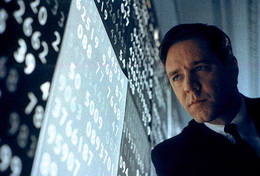
A film about John Nash, the genius mathematician with severe schizophrenia could have been brilliantly interesting. I think it’s a good film, but not as brilliant as it perhaps could have been.

Russell Crowe plays the mathematician in his greatest role to date. He won is best actor Oscar the year before for his role in ‘Gladiator’, but this is the stronger performance. The film traces his life from college onwards taking into account his relationship with Jennifer Connelly, his workings with the government and finally his winning of the Nobel Peace Prize.
The acting in this film is solid throughout. As well as Crowe and Connelly, we are also witness to strong performances from Ed Harris, Christopher Plummer and Paul Bettany and they all make the most of what they are given.
We are also given an insight into how the mind of someone with schizophrenia works and although he is rude and dismissive, we find ourselves seeing him as the hero and wanting him to succeed against the odds. It’s largely true, but film viewers tend to support the underdog and the Academy is certainly no exception, with so many underdogs from ‘You Can’t Take It With You’ to ‘Slumdog’ triumphing.

What irritates me about this film is similar to the irritation that I have with ‘Braveheart’ in that the film makers have taken a perfectly good true story, changed it to make it more Hollywood and then sold it off as a true story. There are so many aspects of Nash’s life that were so interesting and yet were omitted to make it more user friendly. The story with his wife was given a sense of romantic naivety. She was his first love and then they lived happily ever after. This is nonsense. He had a previous wife and child and Connelly’s character left Nash when things got difficult. Now that is a story worth telling. Nash was also arrested for soliciting in a toilet, yet his homosexual tendencies are totally left out of the film. Now, I understand that every aspect of someone’s life cannot be portrayed in a two hour film, but I feel that I was almost lied to in ‘A Beautiful Mind’. I almost do not mind being lied to if it makes the story more interesting but why pretend that the couple lived happily ever after if that wasn’t the case.

The storyline regarding the workings with the government I also feel is a bit over the top. At times I feel the schizophrenia storyline is bypassed in order to make the international spy storyline more accessible with more action sequences than were really necessary.

In short, ‘A Beautiful Mind’ tells a good story and is acted well. But the story told is nowhere near as interesting as it could have been had they been more truthful and not glamorised it for the Hollywood audience.

65. THE DEER HUNTER - 1978

‘The Deer Hunter’ is a Vietnam War saga. The film starts with three men (Robert De Niro, Christopher Walken and John Savage) celebrating their forthcoming trip to Vietnam at Savage’s wedding. The three men are all excited about the prospect of heading to war. Once they arrive in Vietnam they are captured by the Vietcong and forced to play Russian Roulette. When they arrive back in America the repercussions of the events abroad change their lives for ever.

I shall start with the positive aspects of ‘The Deer Hunter’. It’s difficult to deny that the acting in this film is good. It is the best performance that I have ever seen from Walken, and De Niro is always solid. The film also features Meryl Streep in her first Oscar Nominated role, and as a big fan of Meryl Streep, I feel that she adds a great deal to this film.

Another good thing about this film is the impact of a couple of key scenes. The infamous scene where the characters play Russian Roulette is easily one of the most memorable scenes in the history of cinema, and although this has a lot to do with the subject matter, I feel that credit should also go to Cimino’s direction.

There are, however, issues that I have with ‘The Deer Hunter’. I am not entirely sure, even after several watches, what the message the film is trying to put across. Is it pro-American or anti-war? The film portrays the three lead characters as the heroes and the humble wedding scenes and the horrific acts of the Vietnamese certainly place the viewer firmly on the side of the Americans. The dreadful way in which the war affects the soldiers gives the ending of the film an anti-war feeling to rival many other war epics.

I do not suggest for one moment that all films need to be either pro or anti war, and it is perfectly reasonable that a film should be created to show the impact of war on its soldiers without being either for or against it. My problem with ‘The Deer Hunter’ is that whilst it manages to show the impact of the war it largely fails to show the war and what actually impacted them. One moment the protagonists are at a wedding in Pennsylvania, and the next they have been captured and are being made to play death games. There is no transition between the two places and we, as the viewer, never really get to see what life was like in Vietnam and therefore why they have been affected in the way they were. Of course, we saw a couple of horrific scenes, but not enough to give, I felt, a realistic and well rounded picture.

Overall I think that the ‘Deer Hunter’ is a sprawling over lengthy shambles of a film which is partly rescued by some wonderful performances and a few highly memorable scenes.

66. OLIVER! - 1968

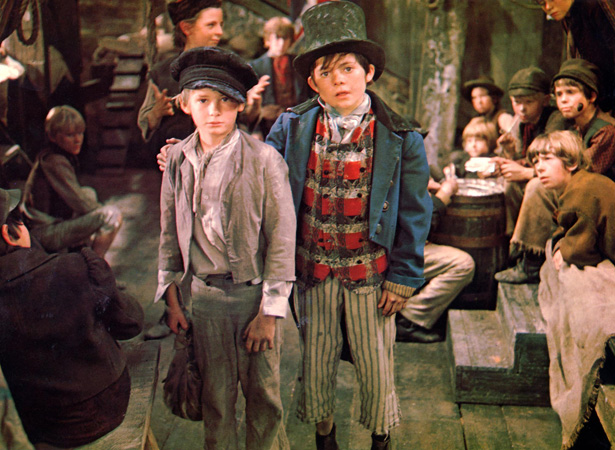
One of the last of the classic musicals was ‘Oliver!’ – a children’s adaptation of the Charles Dickens novel about an orphan who escapes from his life in the workhouse and finds himself working as a pickpocket in Victorian London. The cast includes Jack Wilde as the Artful Dodger, and Ron Moody as Fagin, who both received acting nominations for their performances in this film.

The story of Oliver Twist always strikes me as a interesting subject for the only children’s film to win the Best Picture Oscar, as it deals with (amongst other things) murder, theft, kidnapping, prostitution and violence. What elevates this film above other children’s films is the fact that the characters are not totally one-dimensional. We know that Oliver is the hero of the story and that Bill Sykes, the violent burglar who beats his charming girl, is bad news, but some of the others characters: Fagin, the Artful Dodger, are more interesting.

The film’s dark subject matter is lightened considerably by the wonderful music, and ‘Oliver!’ really does contain some classic numbers: ‘As long as he needs me’ is Nancy’s tear-jerking swansong and a firm favourite of mine, sung perfectly by Shani Wallis, ‘Reviewing the Situation’ is Fagin’s dark number during which he contemplates his life of crime, and ‘Who Will Buy?’ is a gloriously uplifting number, with clever interweaving parts and fun choreography. Some of the stage musical’s songs are omitted, including Sykes’ ‘My Name’, which is a shame, as well as ‘That’s Your Funeral’, which would have added some more adult humour to the film.
The acting is also pretty good for a film of this type, if a little over the top at times from the child actors. Notably good are Ron Moody as Fagin and Oliver Reed as Bill Sykes, who plays a brilliant villain throughout.

Being raised on musicals, ‘Oliver!’ is probably the Oscar winner that I have seen second most often (behind that other family favourite ‘The Sound of Music’), and it almost pains me to place this film at so far down the list. Having said that, whereas the film is thoroughly entertaining and a children’s film that adults can also enjoy, it just cannot compare to some of the greater musicals made. The film simply does not have the style and finesse found in ‘Singin’ in the Rain’, ‘Top Hat’ or ‘Cabaret’ (I have deliberately not included Best Picture winners here) and I don’t think it was a worthy Best Picture winner.

Thursday, 8 April 2010

67. DANCES WITH WOLVES - 1990

‘Dances with Wolves’ was a brave film for Kevin Costner, even if the end result was far from perfect. Coming in at just over three hours, ‘Dances with Wolves’ tells the tale of John Dunbar, a Civil War veteran who is sent to the west frontier. He waits for others in the army to join him, but they never appear. He meets Native Americans and after a while begins to live with them, learn their language, and fall in love with a white girl who had been raised by them since birth.

‘Dances with Wolves’ is set in the west and often billed as a western, but essentially this is a standard white-people-bad / nature-loving-people-good film that 20 years later ‘Avatar’ would copy mercilessly, that just happens to be set in the west. I am not claiming to know much about the treatment of Native Indians by white people, and therefore do not feel remotely qualified to comment on the bias of the film. The film does portray all white men as being totally bloodthirsty and barbaric, which I feel probably over simplifies things slightly, but Costner clearly wanted to make a film about the poor treatment of the Native Indians, so he has done.

It is this one-sided look at the film that is its main weakness and prevents any additional depth being added to the film. As a result the acting probably suffers. Whereas I respect the fact that Costner did not use big name actors to play the roles of the Native Indians, because of the one-sided look of events, the characters are not as meaty and interesting as they could have been.

There are some things about this film that I think should be mentioned. The script is at times very witty and charming, which was a bit of a pleasant surprise and does help to elevate this film from the usual goodies vs badies films (makers of ‘Avatar’ take note). The music is also of a very high quality and era appropriate (no inappropriate Vangelis electro-music here). The best thing, however, about this film is the quite simply wonderful cinematography. The filming is perfect and manages to take the viewer to the wild west and show the beautiful yet hostile surroundings like no other western that I have seen. I have not seen this film on a big screen, but I would love to watch it given the chance.

In short, ‘Dances with Wolves’ is a film with some excellent qualities, but unfortunately the overriding premise of the film was too basic and did not stray away from the simple message that it was trying to deliver.

68. CHARIOTS OF FIRE - 1981

‘Chariots of Fire’ is another sports film that I feel doesn’t quite achieve all it should. It’s much better than ‘Rocky’ that came in further down the list, but it’s still not one of the better Academy Award winners as I think it has some major flaws.

The film tells the tale of British runners in the 1924 Olympic Games, and essentially about their religions. Harold Abrahams (Ben Cross) is Jewish and wants to escape prejudice. Eric Liddell (Ian Charleston) is a devout Scottish Catholic and wants to win for God. Whereas these issues are touched upon, I don’t feel that they are dealt with in enough detail. We never see the prejudice that Abrahams encounters or why he decides to run rather than enter any other sport, and likewise, we are never sure why Liddell believes that God wants him to run. Because of this, as a viewer, we never get to really know the characters and that really does prevent the film being elevated to loftier heights.

I see the above as the fault of the direction and scripting rather than from the acting. The two lead actors handle their roles well and are backed up by a throng of high quality British actors (Nigel Havers, Ian Holm, John Gielgud) whom I actually wanted to see more of. Although the film is long, I felt that some of the scenes were wasted and could have been used to further explore the leading and supporting characters.

I think that because I felt the issues behind the characters were not explored in enough detail and I didn’t feel that I knew the characters well enough, I didn’t really care about the outcome of the race. This leads me to my next problem with most sports films. Generally they tell you all about one competitor and you are expected to get behind that person/team and will them to beat others who may very well have just an important reason for wanting to win. For me that doesn’t really hold up.

The thing that the film is most famous for, perhaps, is the score by Vangelis. The score is undeniably powerful and emotional and I do not deny that he deserved his Academy Award for the score. But I have a slight problem with this as well. The film is set in the 1920s. Everything else about this film tries to be as true to the era as possible: the costumes, language etc, so why on earth couple this with an electronic score, rather than writing music suitable to the decade? The score is lovely, but not remotely appropriate.

In short, ‘Chariots of Fire’ is a film with some merits, but one that I feel will appeal more to sports fans than lovers of great cinema, due to some fairly significant flaws.

69. CAVALCADE - 1933

Some films one watches and then immediately recommends to everyone they know. Some films one realises will only appeal to people with very specific taste. I would not recommend ‘Cavalcade’ to those who love films full of action and CGI special effects. It is a film for those who, like me, want to engulf themselves in early British melodrama, with a gloriously staged script and stern acting. The best word that I can find to describe this period piece is sumptuous.

Based on a Noel Coward play, this film charts the lives of two families (one upstairs, one downstairs) from the Boer War to 1933. The film takes the families through the death of Queen Victoria, the sinking of the Titanic, the Great War, the roaring Twenties and finally the Depression. It takes the families as a micro-study of society as a whole as they are affected by the world events around them.

The characters are, without exception, interesting and played well. Diana Wynyard is especially good. The different events, however, are handled with varying levels of quality. The Great War section of the film is brilliant, there is a wonderfully harrowing montage of war scenes and how the family is affected by this event is not as predictable as may’ve been expected. The Titanic section, however, is about as subtle as a breezeblock, which is a shame as it could have been handled much better.
There is lots of talk of this film being an unworthy and unlikely winner, but in many ways, I see this as an obvious winner. It is what the academy loves: a social epic about how world events change the lives of those involved, and if modern viewers look past the severe cinematography, and contrived script, they will find a film not dissimilar to several much more famous films (‘Gone With The Wind’ and ‘Giant’ to name two).

It is the ending of this film which I find so poignant, although Frank Lloyd would have had no idea at the time. The end scene, between the now elderly couple of the wealthy family is one of hope. They have suffered horrifically, but are now looking forward to the future together. Little did the viewers know that 1933 would be the year that Hitler came to power and a period of further unrest would follow.

As a best picture winner it is perhaps the most dated as it has not aged well. For those of you who want to see a early winner where the filmmakers were coming to grips with sound and more modern techniques, coupled with an interesting insight into events of the first three decades of the 20th Century, then it is definitely worth a watch, but expect to find it interesting, rather than typical Hollywood entertainment.

Tuesday, 6 April 2010

70. DRIVING MISS DAISY - 1989

There’s cinema as entertainment and cinema as great art, and ‘Driving Miss Daisy’ belongs firmly in the former category. ‘Driving Miss Daisy’ is a very watchable, very enjoyable sentimental film that contains a solid performance from Morgan Freeman, and a brilliant performance from Jessica Tandy.

Jessica Tandy plays the title role, an aging, difficult widow in 1950s Georgia, who is old fashioned in her views, and passively racist. When she crashes her car, her son hires Morgan Freeman to be her chauffeur, much to the horror of Tandy. Over the years, however, she warms to his kind nature, and they learn to coexist, and then become firm friends.

It is a hard-warming film that, to its credit, does not become preachy. This is largely due to the performance of the two lead actors, who remain give honest, balanced performances. Jessica Tandy is believable as the prickly pensioner, but never becomes a caricature of herself, and although Morgan Freeman’s character is clearly a nice man, he is still human and not without imperfections.

Having said all this, the film does not excel in many other areas (although the score is marvellous). Aside from the acting the film has little to rave about. I wouldn’t say that anything in the film is bad, but just not particularly notable. The script is fine, the direction adequate, and the supporting cast largely forgettable. The trouble with the film as a viable Oscar best picture winner is that it’s almost too small. It’s a lovely character study, but in order to rate this any higher, I need to find something else to latch onto, other than the performances of the lead roles. Whereas, I was totally drawn in by the characters, I was not drawn in by the film at all.

Some would argue that beautiful sweeping cinematography or a wittier script, would not be appropriate for such a film as this, and they may be right, but I personally think that a best picture award is also not appropriate for a film such as this.
I like this film and I have seen it many more times than some of the films ranked higher on the list, but I like it because of Tandy and Freeman and not because it is particularly wonderful piece of art.